Learn More
Scientific background, dataset development, AI model validation, and publication information
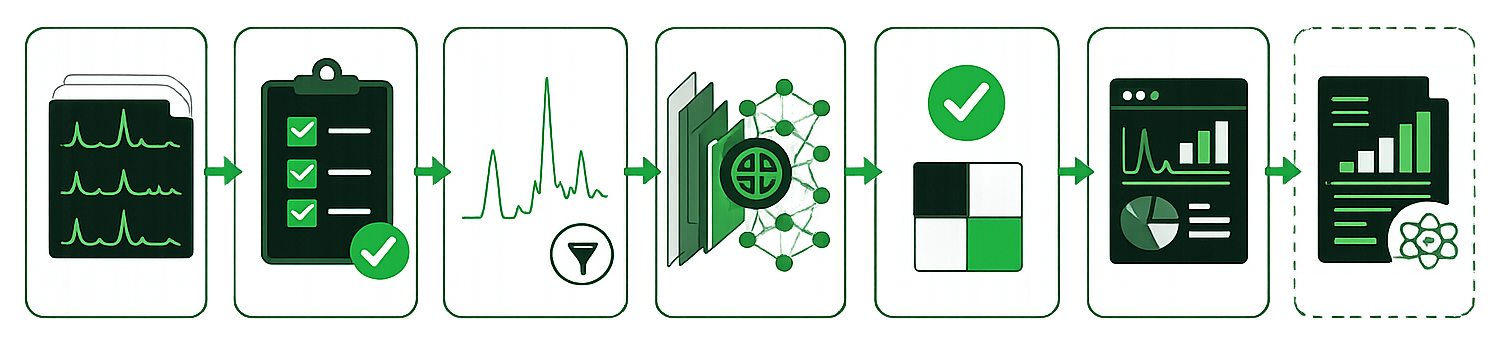
This tool is based on experimentally measured FTIR spectra and deep learning models developed for the characterisation of mixed plastic waste streams, with a specific focus on End-of-Life Vehicles (ELV) and Waste Electrical and Electronic Equipment (WEEE) plastics and recycled polypropylene-rich fractions.
The plastic-classification model is developed using manually verified FTIR spectra of WEEE-relevant plastic materials. The current model supports PP, PE, ABS, HIPS, PC/ABS, PA, and PVC. The dataset includes spectra from samples with different sources, colours, density, and material conditions to improve robustness for real recycling applications.
The filler-estimation model focuses on polypropylene-rich materials and was developed using FTIR spectra of PP samples containing known amounts of common mineral fillers based on lab-produced formulations. The current filler module estimates talc content, calcium carbonate content, and total filler content.
The platform uses convolutional neural network-based models to extract relevant spectral features from FTIR measurements. Before prediction, uploaded spectra are processed using standardized preprocessing methods to reduce irrelevant spectral variation, including baseline effects, intensity differences, and measurement noise.
During model development, the datasets were divided into training, validation, and test subsets to evaluate model generalization. Model performance was assessed using classification metrics for plastic identification and regression metrics for filler estimation.
The current plastic-classification model is limited to the supported plastic classes listed above. Samples outside the training scope, strongly contaminated materials, multilayer plastics, highly degraded samples, incompatible FTIR measurement settings, or polymer blends not represented in the dataset may lead to lower-confidence predictions.
XRF integration is an optional reporting feature. Br, Sb, and Cl values are extracted from matching XRF files and merged with the FTIR-based output table. XRF values are not used by the FTIR AI models and do not influence the plastic-classification or PP filler-regression predictions.
For questions about the FTIR Plastic and Filler Analysis Tool, contact ftir@sude.be.